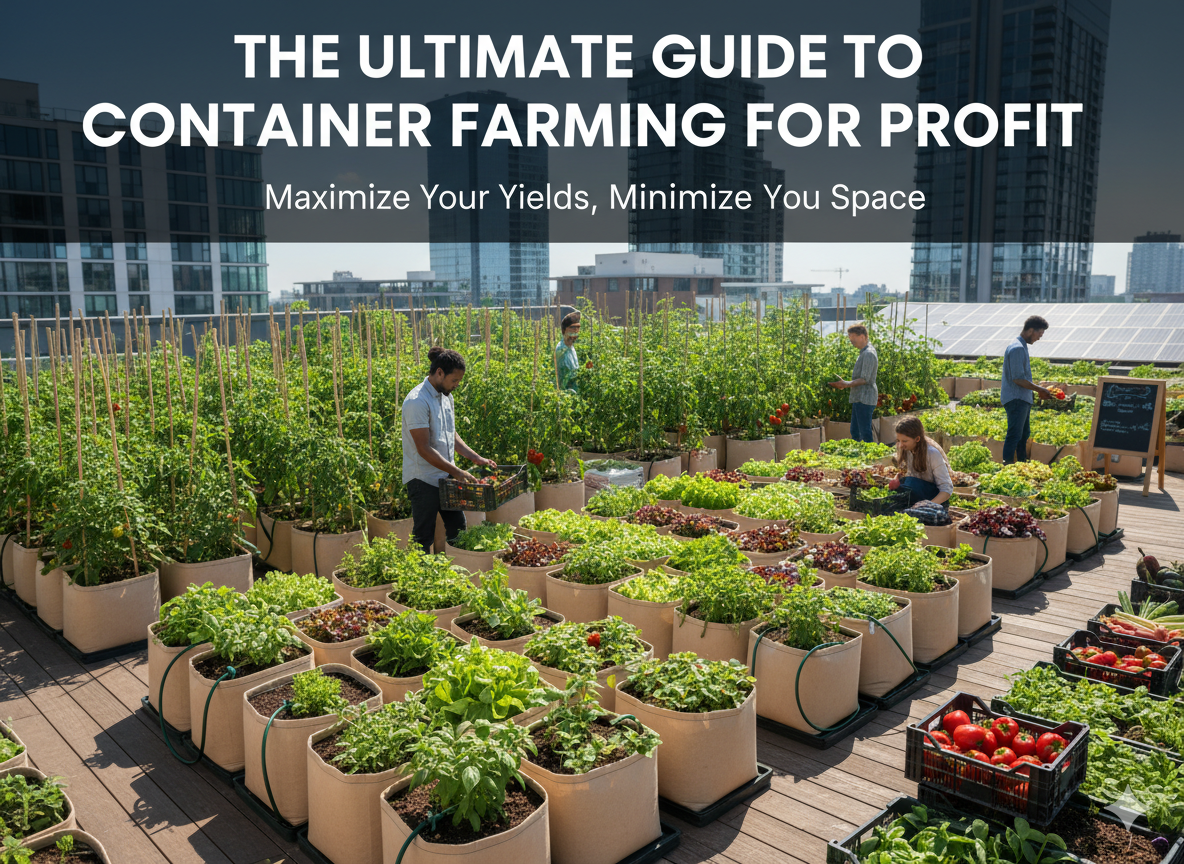
If you’re an entrepreneur looking for a new business, a community group trying to make sure everyone has food, or a grower interested in indoor farming, container farming is a great way to do it that can be scaled up. Of course, it’s not always easy.
What Is Container Farming?
Container farms are controlled-environment growing facilities built inside repurposed freight shipping containers or purpose-built modular units. They use hydroponic systems, LED lighting, and climate control to grow crops year-round, completely independent of outside weather conditions.
There are two distinct types you’ll encounter in the market:
1. Retrofitted Shipping Containers: Used freight containers that have been outfitted with growing systems. These are lower upfront costs but come with significant structural and operational trade-offs (more on this below).
2. Custom-Fabricated Modular Units: Purpose-built growing environments that resemble prefabricated buildings more than shipping containers. Companies like Modular Farms lead this space. These are designed from the ground up for plant cultivation and tend to outperform retrofitted options in virtually every metric.
Understanding the difference between these two is one of the most important decisions you’ll make as a buyer.
The Good: Why Container Farming Is Taking Off?
Plug-and-Play Setup
Container farms are remarkably easy to get started with. Water hookups typically require just two inlets, two outlets, and one overflow pipe connected to an external system. Power is equally straightforward: one plug for lights and irrigation, another for the climate control unit. That’s it. You can be growing within days of installation.
Location Flexibility
You can set these farms up almost anywhere: an empty lot, a rooftop, a parking area, or unused grassland. Because they’re classified as mobile buildings in most jurisdictions, the permitting and approval process is often faster and simpler than traditional construction.
Scalability
Most operators start with a single container to validate their business model, then scale up. You can link containers side by side to expand capacity, or, where horizontal space is limited, stack them vertically. And if a landowner ever needs the site back, you can relocate the farm. That kind of flexibility is genuinely rare in agriculture.
Year-Round Production, Any Climate
Whether you’re in a desert or the Canadian subarctic, a container farm produces crops 52 weeks a year. The Churchill Northern Study Center in northern Manitoba, for example, runs a container farm through brutal winters and sells fresh rocket greens locally, something that would be impossible with traditional outdoor growing in that region.
Dramatically Reduced Resource Use
Compared to conventional soil farming, container farms use approximately 1% of the water and fertilizer. With five growing layers and fast growth cycles, output can be up to 100 times higher per square foot than traditional farmland.
Modular and Shippable
The form factor is ideal for transport. Because the infrastructure for moving shipping containers already exists globally, getting your farm to a remote or unconventional location is far more achievable than building a greenhouse or warehouse from scratch.
The Bad: Challenges You Need to Understand
Containers Weren’t Designed for Growing
Shipping containers were engineered to move products across oceans efficiently. Intent informs design, and a container’s design intent has nothing to do with cultivating plants.
Converting them into growing environments requires significant modification, and even after modification, they’ll always be a compromise. Environmental control, lighting layout, and airflow are all harder to optimize in a space that wasn’t built for the task.
Environmental Control Is Genuinely Difficult
Humidity management, heat dissipation, and CO2 regulation become challenging in tight, enclosed spaces. The relationship between light and heat is especially important: there’s a near-linear relationship between light input and biomass output, which means you want to maximize light, but in a cramped container, more light means more heat, and more heat means more HVAC load.
The layout of your growing system directly affects how much light you can safely run.
Wider aisles, better air circulation, and more space between towers allow you to run higher-powered lights and produce significantly more plant material per square foot. Dense, cramped setups force you to throttle light and, therefore, throttle output.
Structural Deterioration in Used Containers
Used shipping containers have lived rough lives, decades of saltwater exposure, UV radiation, wind, and heavy handling. By the time they’re sold off, it’s often because they’re at the end of their useful life as freight containers.
Some farmers have had their used containers condemned by local authorities due to roof collapse. If you’re considering a retrofitted used container, inspect it thoroughly before purchasing and factor long-term maintenance costs into your financial model.
Ergonomics and Working Conditions
The standard shipping container interior is roughly 7.5 feet wide and 8.5 feet tall. It can feel claustrophobic, especially during the hours of weekly maintenance and harvesting that come with running a farm.
Before committing, visit actual operating farms and spend time inside. You or your employees will be working in this environment regularly. Make sure it’s sustainable.
Specialized Knowledge Required
Indoor farming demands a fundamentally different skill set from outdoor growing. Rather than adapting to weather, you’re responsible for creating every condition your plants need: light spectrum and duration, nutrient concentrations, temperature, humidity, and CO2 levels. The learning curve is real, and mistakes can wipe out entire harvests.
The Ugly: Financial Realities
“Cheap” Is Never Actually Cheap
Used shipping containers are inexpensive up front, but that low CAPEX often gets transferred into higher OPEX over time. You’ll spend more on repairs, maintenance, and inefficiency than you would have if you’d invested in a purpose-built system from the start. As one industry veteran puts it: cheap is not always the best way to go.
Operating Costs Are Substantial
Using the Churchill project as a real-world baseline, operating costs for a container farm run approximately $30,000–$40,000 per year. This assumes a part-time labor allocation; the unit itself requires roughly 20–30 hours per week of attention, not a full-time employee.
Costs will vary significantly by location (electricity prices, local wages, shipping costs for supplies), so always model your specific situation before committing.
Profitability Depends on Local Conditions
Container farms only make clear financial sense where electricity is relatively affordable, and crops command good prices. Before investing, run the numbers on your local electricity rates, competing produce prices, and realistic sales volume.
If your goal is to test indoor farming in a new location, a container farm is an excellent low-risk entry point — but don’t go in assuming profitability without doing the math first.
The Key Metric: Dollars of CAPEX Per Pound of Output
One of the most important financial concepts in container farming, and one that’s frequently misunderstood, is not how many heads of lettuce you produce. It’s how many pounds of output your farm generates annually, relative to your total capital expenditure.
Here’s why this matters: a farm that costs $90,000 and produces 2,000 lbs/year looks cheaper upfront than one costing $135,000. But if that $135,000 farm produces 4,000 lbs/year, it’s a dramatically better investment on a per-pound basis. As markets become more competitive, this efficiency gap compounds.
Always demand this number from vendors. Always calculate it for your own model. Pounds of output per dollar of CAPEX (and OPEX) is the most truthful metric for evaluating a container farm’s economic viability.
A standard container farm system can produce approximately 400–450 heads of lettuce per week, roughly 20,000+ heads per year. Converting that to pounds will depend on your specific crop and harvest weight, but this gives you a baseline for modeling revenue.
Business Models That Work
The For-Profit Model
Selling fresh greens directly to restaurants, retailers, and consumers at a price premium is the most common approach. Local produce commands higher prices than commodity supply-chain alternatives, and the year-round consistency of container farming is a genuine selling point for food service buyers.
The key is understanding your market before you plant your first seed. Who are your customers? What will they pay? How many units per week can you reliably move? Build your harvest plan around those answers and treat it like a business, not a hobby.
The Community and Hybrid Model
Not every container farm needs to turn a direct profit. Research and education organizations, Indigenous community groups, and northern or remote communities often run container farms primarily for food security rather than revenue generation.
One practical hybrid model that has demonstrated real-world success: sell approximately half of weekly production at market prices to generate the ~$40,000 in annual revenue needed to cover operating costs. Donate or distribute the remaining half to community members in need, food banks, or partner organizations. Once you’ve reached break-even through sales, everything above that threshold is surplus available for community benefit.
If your organization can reliably raise $40,000/year in donations or grants, a 100% donation model becomes viable; everything grown goes directly to the community.
The Research and Training Model
Container farms make excellent platforms for agricultural research, workforce training, and knowledge transfer. The Churchill Northern Study Center has used its unit to train interns who’ve gone on to operate hydroponic farms elsewhere in Canada — building regional expertise in a sector that desperately needs it.
Before You Buy: A Due Diligence Checklist
Talk to operators who have both succeeded and failed with the product you’re considering. Every reputable manufacturer should be able to connect you with real customers. Get the full picture — not just the success stories.
Visit farms in person. Spend time inside different form factors. Assess the working environment, the layout, and the access to plants. Can you comfortably walk the aisles? Can you inspect plants at every level?
Understand your local cost structure. Electricity prices, labor costs, local crop prices, and regulatory requirements all vary enormously. A model that works in one location may not work in another.
Model CAPEX and OPEX together. Don’t evaluate the purchase price in isolation. Calculate your total cost of ownership over 5–10 years, including maintenance, consumables, utilities, and labor.
Focus on pounds, not heads. Demand annual pound output projections from vendors, then calculate dollars-per-pound. This single metric will cut through most of the marketing noise.
Choose new or custom overused if possible. The cost difference is often smaller than the long-term headaches that come with aging and deteriorating containers.
Final Thoughts
Container farming is not a get-rich-quick scheme, but it is a genuinely viable agricultural model when entered with clear eyes and realistic expectations. The technology works. The business models work when designed thoughtfully for the specific context. The community impact can be profound, particularly in remote, northern, or food-insecure regions.
The operators who succeed are the ones who do their homework, run their numbers honestly, treat the operation like a real business, and choose their equipment based on output per dollar rather than sticker price.