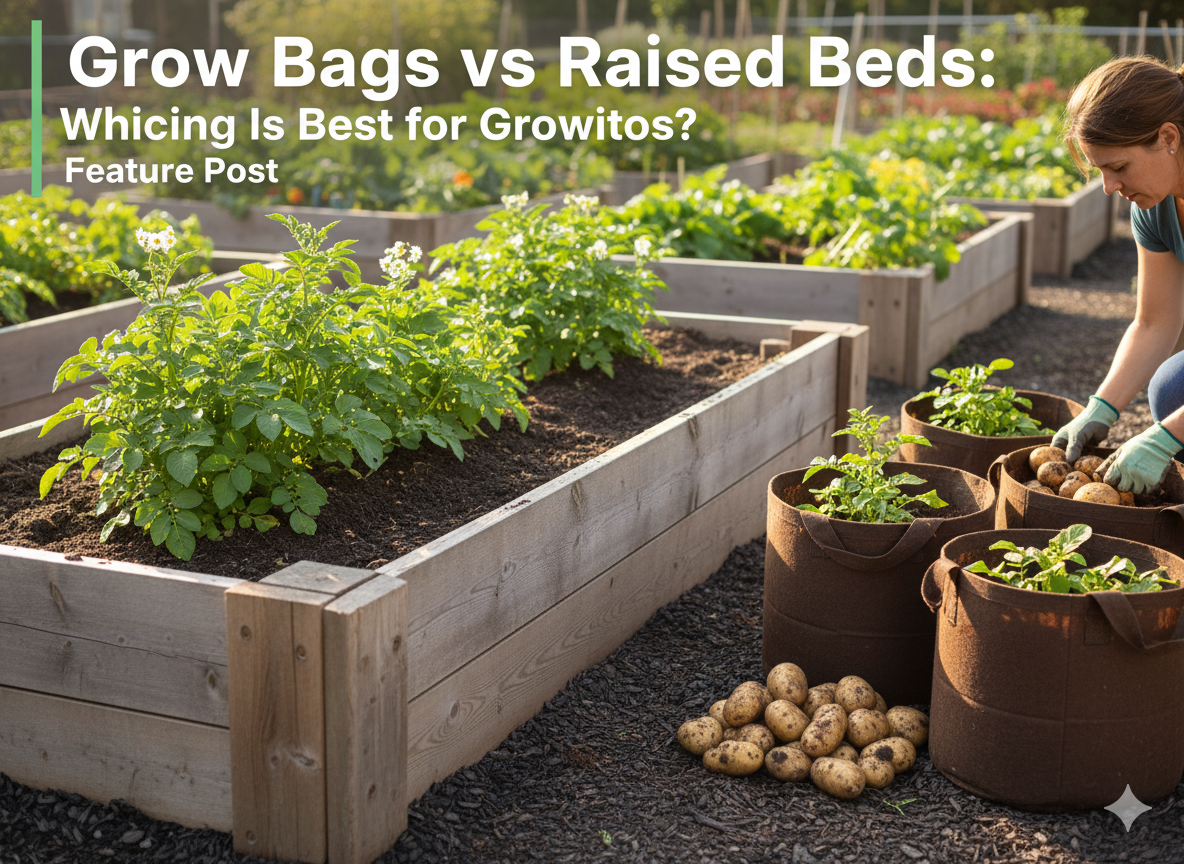
If you’ve ever stood in your garden wondering whether to invest in raised beds or grab a stack of grow bags for your potato crop, you’re not alone. Both methods have passionate advocates, and the honest answer is: it depends on your soil, your climate, and how closely you’re paying attention to watering.
The Core Difference Between the Two Methods
Raised beds and grow bags are both forms of contained growing, but they behave very differently in practice. A raised bed sits on existing ground, often sharing drainage properties with the native soil beneath it.
A grow bag, usually made of breathable fabric, is completely isolated; it drains faster, heats up more quickly, and dries out sooner.
For potatoes specifically, these differences matter a great deal. Tubers are sensitive to both waterlogged soil and heat stress in the root zone. Get it wrong, and your harvest suffers.
Soil Quality: The Factor That Matters Most
One of the clearest lessons from hands-on potato growing comparisons is that soil quality often outweighs container type. In side-by-side tests, raised beds filled with nutrient-rich, fresh compost have outperformed grow bags filled with older, depleted growing medium, even when the grow bags were deeper and theoretically offered more root space.
Conversely, when grow bags are filled with a light, airy potting mix or fresh compost blend, they can match or even exceed raised bed yields. The reason is simple: potatoes need well-draining, loose soil to develop tubers freely.
Heavy, clay-laden raised bed soil, which can happen when topsoil is mixed in without sufficient compost amendment, restricts tuber development and retains too much moisture, increasing disease pressure.
Before debating the container, fix your soil. Either method works well with the right growing medium.
Drainage and Watering: Where Grow Bags Have an Edge
Fabric grow bags naturally prevent overwatering through a process sometimes called “air pruning.” Excess moisture passes through the breathable walls. This is particularly valuable in regions with unpredictable rainfall or high humidity, where raised beds can become waterlogged.
However, this advantage flips during hot, dry stretches. Grow bags dry out significantly faster than raised beds, which means they demand more frequent irrigation. Growers who rely on drip irrigation need to dial in their system carefully; inconsistent watering during tuber development leads to uneven sizing and reduced total yield.
Raised beds, especially deeper ones filled with quality amended soil, tend to hold moisture more evenly. In climates with wet springs and hot summers, this buffer can be an advantage as long as the soil drains well enough not to become waterlogged.
Heat and Tuber Development
Potatoes do not form tubers well in hot soil. This is one of the most overlooked factors in potato growing, and it affects both methods differently.
In raised beds, position within the bed matters. Potatoes planted along the outer edges are exposed to more ambient heat, and those in the center, more insulated by surrounding soil, tend to produce better.
This isn’t a minor detail: growers who track their harvests often notice meaningfully larger yields from center-planted seed potatoes versus those planted near the perimeter.
Grow bags, being fully exposed on all sides, can heat up rapidly on sunny days. This is a significant limitation in warm climates. However, placing grow bags in partial shade during the hottest part of the day, or using lighter-colored bags that reflect heat, can mitigate the problem.
Yield Comparisons: What Real-World Testing Shows?
When the same varieties are grown side-by-side with comparable soil and fertilization, yields tend to be close, but grow bags often edge ahead slightly when soil conditions are equalized.
Here are some representative figures from real comparative harvests:
| Variety | Raised Bed Yield | Grow Bag Yield |
|---|---|---|
| Adirondack Blue | ~4.0 lb (2 plants) | ~4.1 lb (2 plants) |
| Red Cloud | ~4.0 lb (2 plants) | ~4.4 lb (2 plants) |
| Huckleberry Gold | ~3.2 lb (2 plants) | ~3.9 lb (2 plants) |
| Yukon Gold (fertile bed) | 5.85 lb (8 plants) | 3.1 lb (8 plants) |
| Pontiac Red (fertile bed) | 6.42 lb (8 plants) | 4.1 lb (8 plants) |
The pattern here is telling. When the raised bed soil was significantly more fertile than the grow bag mix, raised beds won decisively. When nutrition and soil quality were roughly equivalent, grow bags performed at least as well — and in some cases slightly better, particularly for specialty and mid-season varieties.
Variety Matters More Than You Think
Not all potato varieties respond the same way to each growing method. Early-season varieties do well in both setups, as they finish before summer heat peaks. Mid-season varieties are more demanding, needing consistent moisture and cooler soil temperatures during their longer growing window.
Some general observations:
- Yukon Gold tends to underperform in both systems unless conditions are ideal. It’s more sensitive to heat and disease pressure than other varieties.
- Purple-fleshed varieties (like Purple Viking or Adirondack Blue) often show more resilience, producing solid harvests even in less-than-ideal growing conditions.
- Red varieties (like Pontiac Red or Red Cloud) often have longer dormancy periods, making them better candidates for pantry storage — a practical consideration beyond just raw yield.
Practical Considerations for Each Method
Raised Beds
Pros:
- Better moisture retention in hot, dry climates.
- Easier to scale — one large bed holds many plants.
- More stable temperature environment (especially for center plants).
- Generally, lower per-plant watering demand.
- Longer useful life with proper care.
Cons:
- Soil can become compacted or clay-heavy over time without regular amendment.
- Harder to move or reposition.
- Edge plants may underperform due to heat exposure.
- Waterlogging is a real risk in wet climates without good drainage.
Grow Bags
Pros:
- Excellent natural drainage prevents overwatering.
- Easy to empty, clean, and refill with fresh growing medium each season.
- Portable — can be repositioned for optimal sun or shade.
- Ideal for small spaces, patios, and balconies.
- Force fresh soil each year, which can reset disease pressure.
Cons:
- Dry out faster — demand more attentive irrigation.
- It can overheat in full sun during summer.
- Cost adds up if you’re growing at scale.
- Less margin for error on watering in warm climates.
How to Set Both Methods Up for Success?
Regardless of which approach you choose, a few principles apply universally:
1. Start with exceptional soil. Potatoes need a loose, well-draining growing medium. For raised beds, use a blend of quality compost and aged manure, avoiding heavy topsoil. For grow bags, a potting mix cut with compost works well to avoid anything that compacts easily.
2. Fertilize at planting. A balanced potato-specific fertilizer applied at planting sets tubers up for strong early growth. Both methods benefit equally from this practice, and it eliminates one of the most common variables that skews comparison results.
3. Water consistently. Irregular watering, especially during tuber set, causes uneven sizing and cracking. Grow bag growers should invest in a timer-controlled drip system or commit to daily monitoring in warm weather.
4. Mind your spacing. Planting one seed potato per square foot is a good general rule. Overcrowding reduces airflow, increases disease risk, and forces competition for nutrients.
5. Think about placement. In raised beds, favor the center of the bed for your best seed potatoes. In grow bags, consider shade cloth or afternoon shade positioning in hot climates.
Which Should You Choose?
If you have limited space, poor native soil, or want maximum flexibility, grow bags are the smarter starting point. They’re lower-commitment, easier to optimize, and surprisingly productive when loaded with quality growing medium.
If you’re growing at any scale, gardening in a climate with hot, dry summers, or want a more hands-off system, a well-amended raised bed is hard to beat. The key is treating the soil as a living system, adding compost each season, and avoiding the compaction that slowly kills potato yields.
The real answer isn’t which container wins. It’s that the container is almost secondary to what you put inside it.
Frequently Asked Questions
How deep should the soil be for growing potatoes in grow bags or raised beds?
Potatoes need a minimum of 10–12 inches of loose growing medium to develop well. Grow bags should be at least 10 gallons (ideally 15 gallons) per two plants. Raised beds should be at least 10–12 inches deep, mounded further if possible.
Can I reuse the grow bag soil the following season?
It’s not recommended. Potato soil can harbor disease and pest eggs that overwinter in the medium. Starting fresh each season is one of the biggest advantages of grow bags — empty, clean, refill, and you’ve essentially eliminated soil-borne disease carryover.
How many seed potatoes go in a 15-gallon grow bag?
Two seed potatoes per 15-gallon bag is the sweet spot. It gives each plant enough root space and nutrient access without competing too aggressively.
Do potatoes in grow bags need more fertilizer?
Potentially, yes. Because grow bags drain more freely, nutrients can leach out faster. Using a slow-release fertilizer at planting, plus a liquid feed mid-season, helps compensate.
What’s the best way to know when potatoes are ready to harvest?
Watch for foliage die-back — when leaves yellow and collapse, the plant has stopped photosynthesizing, and tubers won’t grow further. At that point, harvest promptly regardless of whether die-back is from maturity or disease, as leaving tubers in the ground serves no purpose once the plant is dormant.
Does the color of a grow bag matter?
Yes, somewhat. Dark-colored bags absorb more heat, which can stress potato roots in summer. Light-colored or tan fabric bags stay cooler and are a better choice for hot climates.