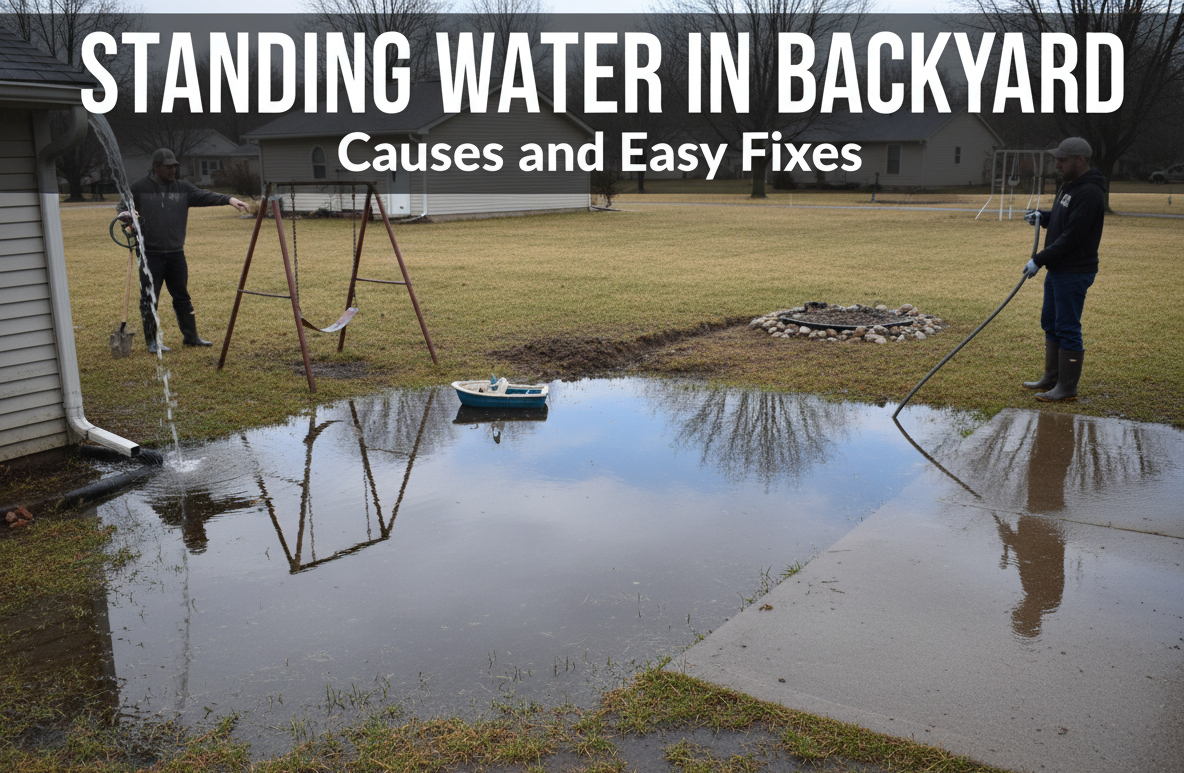
If you’ve ever stepped outside after a rainstorm and found your backyard resembling a shallow pond, you’re not alone. Standing water is one of the most common and most frustrating problems homeowners face.
Beyond ruining your lawn and garden, it creates mosquito breeding grounds, weakens your home’s foundation over time, and can even signal deeper soil or grading issues that won’t fix themselves.
I dealt with this firsthand in my own backyard. After two consecutive wet springs, I noticed a low-lying section near my fence line that refused to drain. Water would sit there for three to four days after any significant rain.
After consulting with a local landscaper and conducting thorough research, I identified the cause and resolved it with a combination of regrading and a simple French drain. The difference was immediate and lasting.
Why Does Water Pool in Your Backyard?
Standing water doesn’t just happen randomly. It’s almost always the result of one or more identifiable causes. Understanding the root problem before spending money on a fix is critical.
1. Poor Grading (Slope Issues)
The most common cause. If your yard slopes toward your house rather than away from it, or if it has low spots or flat sections, water has nowhere to go. The ground collects it.
According to the University of Minnesota Extension, the land immediately surrounding a home should slope at least 6 inches over the first 10 feet away from the foundation to ensure proper drainage.
2. Compacted Soil
Heavy clay soils, or any soil that has been compacted by foot traffic, vehicles, or construction, cannot absorb water efficiently. Water sits on the surface because it has no path downward. This is especially common in newer construction, where topsoil was stripped and replaced with fill.
3. Hardpan Layer Underground
Even in yards with good surface-level soil, a dense hardpan layer a foot or two below the surface can block downward water movement. This is a natural geological feature in many regions and often requires aeration or deep drainage solutions.
4. Blocked or Absent Drainage Systems
Clogged gutters, downspouts that discharge too close to the house, or missing yard drains can all contribute to water pooling. If your gutter system dumps large volumes of water onto the same spot repeatedly, that area will eventually become a persistent problem zone.
5. High Water Table
In some regions, particularly coastal areas or low-lying plains, the natural water table sits close to the surface. After heavy rainfall, the ground becomes saturated quickly and cannot absorb more water. This is the most challenging scenario because no simple DIY fix will fully resolve it.
Easy to Advanced Fixes for Standing Water
Fix 1: Regrade the Yard
For minor grading issues, adding topsoil to low spots and raking the yard to encourage water movement toward a drain or the street is often enough. This DIY project costs more than topsoil and labor.
For larger grading corrections, hiring a landscaper with a skid steer runs roughly $500–$2,000, depending on yard size. This is the most permanent fix when grading is the root cause.
Fix 2: Aerate Your Lawn
Lawn aeration using a core aerator to pull plugs of soil out of the ground breaks up compaction and improves water absorption dramatically. You can rent a core aerator for $70–$100 per day at most hardware stores, or hire a lawn service for similar rates.
For best results, aerate in the fall or early spring when the soil is moist but not waterlogged. Then, overseed and top-dress with compost to improve long-term soil structure.
Fix 3: Install a French Drain
A French drain is a gravel-filled trench with a perforated pipe that redirects underground water away from problem areas. It’s one of the most effective and lasting solutions for chronically wet zones.
DIY installation runs $200–$600 in materials. Professional installation typically costs $1,000–$5,000, depending on length and complexity. The Bob Vila team offers a solid step-by-step guide if you’re considering the DIY route.
Fix 4: Build a Rain Garden
A rain garden is a planted depression that collects stormwater runoff and allows it to slowly absorb into the ground. It turns a drainage problem into a landscape feature. Native plants with deep root systems are key; they open up soil channels and tolerate both wet and dry conditions.
The EPA’s green infrastructure resources recommend rain gardens as a sustainable alternative to piped drainage, particularly in urban and suburban settings.
Fix 5: Add a Dry Creek Bed or Swale
A swale is a shallow, vegetated channel that directs water flow across a property. A dry creek bed serves the same function but uses decorative rock for aesthetic appeal. Both are effective for yards that receive concentrated water flow from neighboring properties or roof runoff.
Drainage Solutions at a Glance
| Solution | Best For | DIY Friendly? | Estimated Cost | Long-Term Effectiveness |
|---|---|---|---|---|
| Regrading | Low spots, slope issues | Partially | $50–$2,000 | High |
| Core Aeration | Compacted soil | Yes | $70–$200 | Medium (repeat annually) |
| French Drain | Persistent wet zones | Partially | $200–$5,000 | Very High |
| Rain Garden | Runoff from roofs/streets | Yes | $100–$800 | High |
| Dry Creek / Swale | Surface water flow | Yes | $200–$1,500 | High |
| Catch Basin Install | Large water volumes | No | $1,000–$3,500 | Very High |
3 Real-World Examples
The Compacted New-Build Backyard — Ohio
A family that purchased a newly built home noticed their backyard flooded after every moderate rainstorm. The culprit: the builder had used heavy clay fill during construction, and no topsoil or drainage system was included.
They hired a landscaper to aerate, add 4 inches of compost-amended topsoil, and install a simple swale along the fence line. Total cost: approximately $1,800. Flooding stopped almost entirely within one season.
The Low-Lying Corner — Pacific Northwest
A homeowner in a high-rainfall region had a corner of her yard that stayed wet nearly year-round due to a combination of heavy rainfall, clay soil, and a slightly uphill neighboring property that directed runoff into her yard.
The solution was a 40-foot French drain that connected to a dry well at the low end of the property. DIY project, completed over a weekend. Materials cost: $380. The area has been dry ever since.
Downspout Discharge Issue — Georgia
A suburban homeowner couldn’t figure out why one section of his lawn was always muddy. After closer inspection, he realized a downspout extension was terminating just two feet from the problem area, dumping thousands of gallons of roof runoff in the same spot every time it rained.
The fix cost him $18: a longer, flexible downspout extension that redirected water toward the street. Sometimes the solution is remarkably simple.
When to Call a Professional?
If you’ve tried basic fixes and water continues to pool, or if you suspect your home’s foundation may be affected, it’s worth bringing in a certified drainage contractor or landscape architect.
Persistent standing water near a foundation can lead to basement moisture problems, structural settling, and mold issues that cost far more to remediate than a proper drainage system installed proactively.
Look for contractors certified through the National Association of Landscape Professionals (NALP) or ask your local cooperative extension office for referrals.
Conclusion
Standing water in your backyard is a solvable problem in the vast majority of cases. The key is diagnosing the actual cause, whether that’s grading, soil compaction, a blocked drain, or something else entirely, before spending money on a fix.
Start with the simplest and least expensive solutions first, document what works, and escalate from there if needed.
The fixes outlined here are the same ones used by landscape professionals and experienced homeowners across a wide range of climates and soil types. None of them requires specialized knowledge to at least attempt at the DIY level, and all of them address root causes rather than just symptoms.